
Turnkey Projects
ZLD & RO Systems
Recover and reuse your wastewater with a ZLD system engineered for your effluent chemistry, recovery target and operating budget.
Quick answer
Zero Liquid Discharge (ZLD) means no liquid effluent leaves the premises: wastewater is treated and recovered for reuse, and the remaining salts are dried for authorised disposal. A typical ZLD system combines pre-treatment, ultrafiltration, high-recovery RO and an evaporator with a dryer. It is often a condition in consents of highly polluting units.
Reviewed by the Aaradhya Enviro compliance team · 18 October 2026
Overview
Zero Liquid Discharge (ZLD) means no liquid effluent leaves the premises: treated water is recovered for reuse and the remaining salts are converted to a solid for safe disposal. ZLD is often a condition in the consent of water-intensive and highly polluting units, and many other industries adopt it to cut fresh water costs.
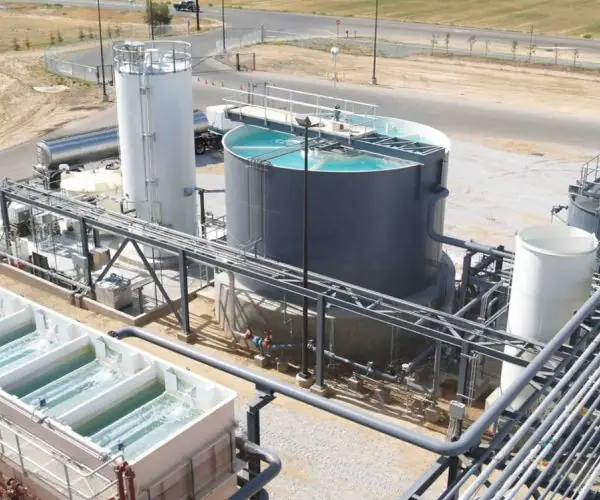
A typical ZLD chain combines pre-treatment, ultrafiltration (UF), reverse osmosis (RO) with high recovery, and thermal systems such as a multiple-effect evaporator (MEE) or mechanical vapour recompression (MVR) followed by an agitated thin-film dryer (ATFD). The design must balance recovery, energy use and scaling or fouling risk. We carry out the water balance and feasibility study first, then design, supply and commission the system.
Who needs this service
- Units with a ZLD condition in their MPCB consent or Environmental Clearance
- Textile, pharmaceutical, chemical, distillery and food processing units
- Plants facing high fresh water costs or limited water availability
- Industries needing process-grade water from RO
What we cover
Water balance & feasibility
Sources, uses, losses and achievable recovery for your site.
Pre-treatment
Softening, clarification, filtration and UF to protect membranes.
Industrial RO
Multi-stage, high-recovery RO with antiscalant and CIP systems.
Reject management
MEE / MVR evaporators, crystallisers and ATFD for salt recovery.
Automation
PLC / SCADA, online meters and data logging for compliance.
Performance support
Membrane health monitoring, cleaning schedules and optimisation.
Our process
-
Step 1
Data & sampling
Effluent and feed-water analysis including hardness, silica and TDS.
-
Step 2
Feasibility
Recovery targets, technology route and lifecycle cost comparison.
-
Step 3
Detailed design
Process design, membrane projections and equipment sizing.
-
Step 4
Supply & erection
Skids, evaporators, piping, instrumentation and controls.
-
Step 5
Commissioning
Stepwise start-up and recovery proving.
-
Step 6
Optimisation
Ongoing monitoring of flux, recovery and energy use.
What you receive
- Water balance and feasibility report
- Process design and membrane projections
- Equipment specifications and layout
- Commissioning and recovery test report
- Operation and CIP procedures
Applicable regulations
- ZLD conditions in MPCB consent / Environmental Clearance
- CPCB guidelines on ZLD for applicable sectors
- Hazardous waste rules for evaporator salts and sludge
Regulations are amended from time to time; we always work to the version currently in force and the conditions in your own consent.
FAQ
ZLD & RO Systems: frequently asked questions
Is ZLD mandatory for my industry?
How much water can a ZLD system recover?
What happens to the salts produced by ZLD?
Related services
ETP & STP Design and Installation
Turnkey Effluent and Sewage Treatment Plants: design, supply, installation, commissioning and handover.
Learn moreTreatability Studies
Lab and pilot trials that prove the right treatment process before you invest.
Learn moreOperation & Maintenance (O&M)
Trained operators, daily logs, testing and preventive maintenance for ETP, STP, RO and ZLD plants.
Learn morePlant Up-gradation & Retrofit
Performance audits, capacity enhancement and retrofits for under-performing treatment plants.
Learn moreFurther reading
Discuss ZLD & RO Systems with our team
Share your requirement and get a clear scope, timeline and estimate.