
Turnkey Projects
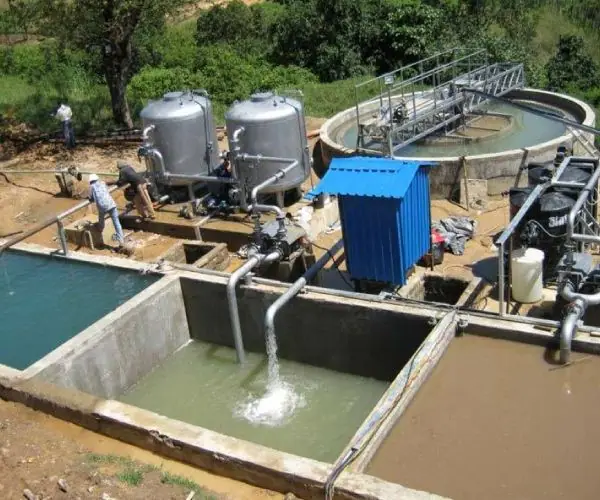
ETP & STP Design and Installation
Treatment plants designed around your actual wastewater, built to meet your consent limits, and handed over with trained operators.
Quick answer
An ETP treats industrial process wastewater; an STP treats domestic sewage from toilets, kitchens and washrooms. A reliable plant is designed from your measured flow and wastewater analysis, not a standard template. Aaradhya Enviro designs, supplies, installs and commissions ETPs and STPs to meet MPCB consent limits, and trains your operators at handover.
Reviewed by the Aaradhya Enviro compliance team · 18 October 2026
Overview
An Effluent Treatment Plant (ETP) treats industrial wastewater that contains chemicals, oil, colour, heavy metals or high organic load. A Sewage Treatment Plant (STP) treats domestic wastewater from toilets, kitchens and washrooms in factories, housing societies, hospitals, hotels and commercial buildings. Many industrial sites need both.
A plant that is designed from a textbook rather than from your actual effluent will fail to meet norms. We start with flow measurement and wastewater characterisation, select the right process (physico-chemical treatment, activated sludge, MBBR, SBR, MBR, tertiary filtration or a combination) and size every unit for your load. We then supply, install and commission the plant, train your operators and stay available for performance support.
Who needs this service
- Chemical, pharmaceutical, engineering, food, dairy and textile units
- Housing societies, hospitals, hotels, schools and commercial complexes
- Units with an existing plant that cannot meet consent limits
- New projects that need a treatment scheme for CTE / EC applications
What we cover
Wastewater characterisation
Flow study and lab analysis of pH, BOD, COD, TSS, TDS, oil & grease and specific pollutants.
Process design
Treatment scheme, mass balance, hydraulic design and P&ID.
Civil & mechanical
Tank sizing, civil drawings, equipment selection, piping and electricals.
Supply & installation
Pumps, blowers, diffusers, media, dosing systems, filters and panels.
Commissioning
Biological seeding, stabilisation and performance proving against norms.
Handover
SOPs, logbooks, operator training and as-built documentation.
Our process
-
Step 1
Site survey
Space, levels, existing drains and power availability are mapped.
-
Step 2
Characterisation
Representative samples are tested to fix the design basis.
-
Step 3
Design & proposal
Process scheme, layout and a transparent bill of quantities.
-
Step 4
Execution
Civil works, equipment erection, piping and electrical installation.
-
Step 5
Commissioning
Trial run, biological stabilisation and treated-water testing.
-
Step 6
Training & support
Operator training, SOPs and optional O&M contract.
What you receive
- Design basis and process flow diagram
- General arrangement and civil drawings
- Equipment list and bill of quantities
- Commissioning and performance test reports
- Operation manual, SOPs and logbook formats
Applicable regulations
- Discharge standards in your MPCB consent
- General standards under Schedule VI of the Environment (Protection) Rules, 1986
- Industry-specific standards notified by MoEFCC / CPCB
Regulations are amended from time to time; we always work to the version currently in force and the conditions in your own consent.
FAQ
ETP & STP Design and Installation: frequently asked questions
Does my factory need an ETP, an STP or both?
What information do you need to quote for an ETP or STP?
Which STP technology is best: MBBR, SBR or MBR?
Can treated water be reused?
Related services
ZLD & RO Systems
Zero Liquid Discharge and industrial RO: water recovery with UF, RO, evaporators and dryers.
Learn moreOperation & Maintenance (O&M)
Trained operators, daily logs, testing and preventive maintenance for ETP, STP, RO and ZLD plants.
Learn morePlant Up-gradation & Retrofit
Performance audits, capacity enhancement and retrofits for under-performing treatment plants.
Learn moreTreatability Studies
Lab and pilot trials that prove the right treatment process before you invest.
Learn moreFurther reading
Discuss ETP & STP Design and Installation with our team
Share your requirement and get a clear scope, timeline and estimate.