
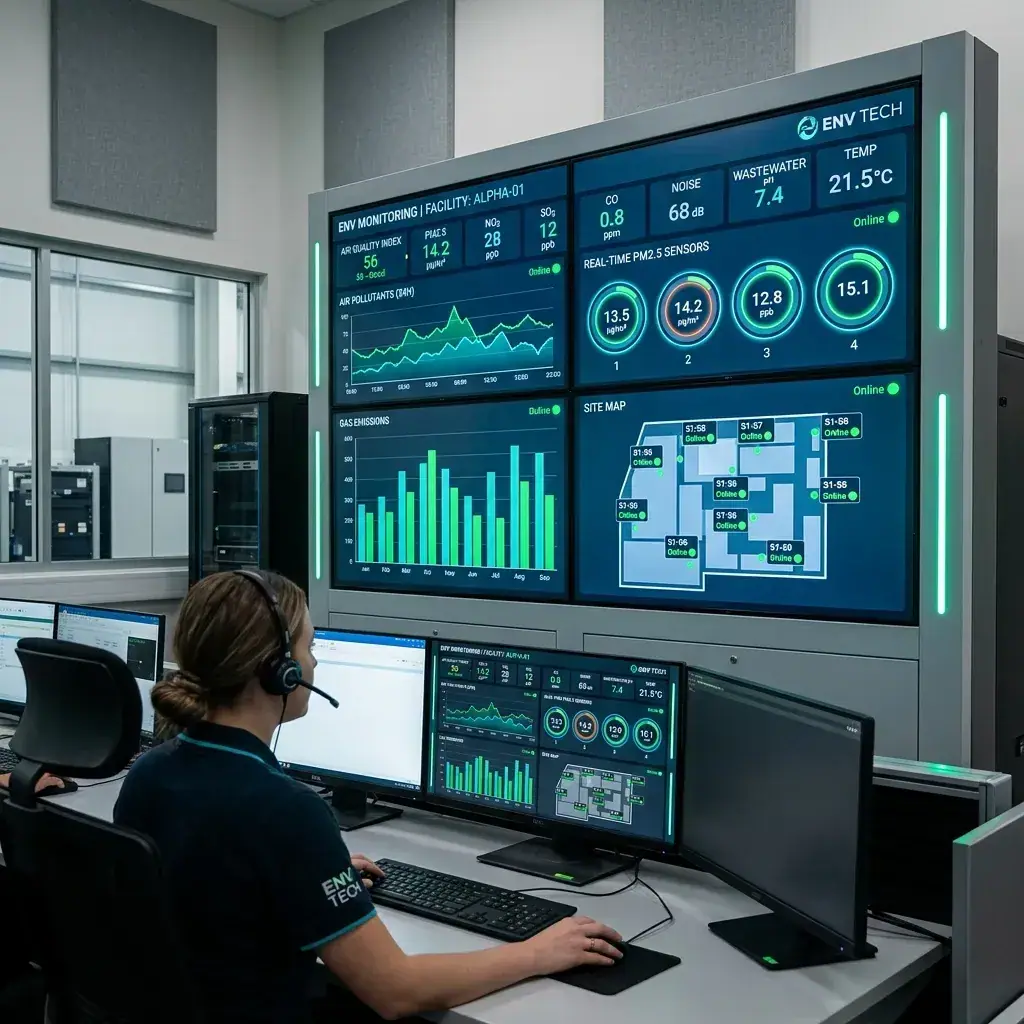
Monitoring
Online Continuous Emission Monitoring (OCEMS)
Inside the real-time telemetry systems that stream compliance data directly to CPCB servers 24/7.
2 min read Aaradhya Enviro technical team
Quick answer
Online continuous emission and effluent monitoring systems measure parameters such as particulate matter, SO₂, NOx, pH, COD and flow in real time and transmit the data to CPCB and MPCB servers. Reliable data needs correct analyser placement, regular calibration and stable data connectivity.
1. The Era of Digital Surveillance
To eliminate the manipulation of manual lab reports and ensure 24/7 compliance, the Central Pollution Control Board (CPCB) mandated the installation of Online Continuous Emission Monitoring Systems (OCEMS) for the 17 categories of highly polluting industries (including cement, pharmaceuticals, and sugar).
2. Sensor Technologies
OCEMS utilizes cutting-edge sensor technology to analyze exhaust gases in real-time, often enduring extreme temperatures and corrosive environments inside the stack:
- NDIR (Non-Dispersive Infrared): Uses infrared light absorption to highly accurately measure CO, CO2, SO2, and NOx.
- Laser Transmissiometers: Fires a laser across the diameter of the chimney to a receiver on the other side. The attenuation (dimming) of the laser accurately calculates the Particulate Matter (PM) concentration.
- Zirconia Sensors: Extremely robust sensors used to measure oxygen levels at high combustion temperatures.
3. Data Telemetry and Alerts
The sensors are connected to a Data Acquisition System (DAS), which encrypts and transmits the readings every 15 minutes to the centralized CPCB server. The system is programmed with threshold limits. If an industry's emissions spike above the legal limit (e.g., PM > 150 mg/Nm3) for an extended period, an automated SMS alert is generated and sent to the plant manager and the regional MPCB officer.